
Published on July 2026
Introduction
For more than two decades, Google has been the primary gateway to the internet.
Whether someone wanted to find a restaurant, learn a new skill, compare products, or hire a service provider, the journey almost always began with a Google search.
This single behavior shaped an entire digital economy.
Businesses invested in websites. Publishers built content libraries. SEO became one of the most valuable digital marketing disciplines. Millions of websites were created around one simple idea:
Create valuable content, rank on Google, attract visitors, and convert them into customers or revenue.
Today, that model is changing.
Not because people have stopped searching.
But because people are searching differently.
Artificial intelligence has introduced a new way of discovering information. Instead of scrolling through ten blue links, users increasingly expect direct answers, personalized recommendations, and conversational experiences.
This shift represents one of the biggest changes to the internet since Google became the world’s dominant search engine.
The Three Eras of Search
Understanding where search is heading becomes easier when we look at how it has evolved.
Era 1: Human Directories
In the early days of the web, websites were organized manually into categories.
If you wanted to find something online, you browsed through directories maintained by people.
Finding information was slow, but the internet itself was still relatively small.
Era 2: Search Engines
Google transformed the web by making information searchable.
Instead of browsing categories, users simply typed a question.
Google’s algorithms determined which pages deserved attention.
This created an entirely new industry around Search Engine Optimization (SEO).
Businesses learned that appearing higher in search results meant:
- More visitors
- More leads
- More sales
- More brand awareness
For nearly twenty years, this model dominated digital marketing.
Era 3: AI-Powered Discovery
Today, we are entering a new phase.
Instead of searching only through lists of links, people increasingly ask questions directly to AI assistants.
They expect immediate answers.
They expect recommendations.
They expect conversations rather than search results.
The internet is moving from a search-first experience to an answer-first experience.
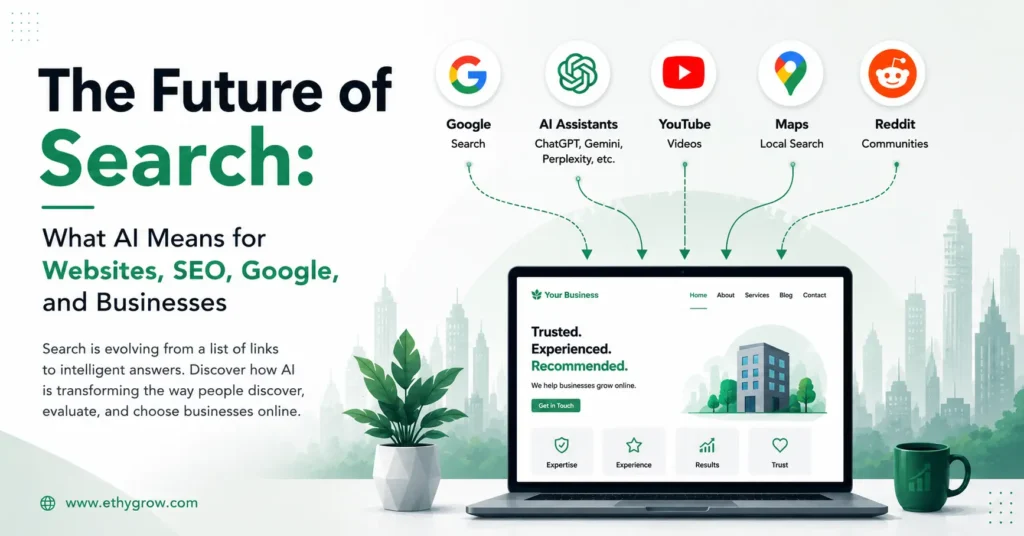
Search Is No Longer One Place
For years, businesses focused almost exclusively on Google.
Today, customer journeys are far more diverse.
Someone researching software may ask an AI assistant.
Someone looking for product reviews may search YouTube.
Someone planning a vacation may use maps and travel platforms.
Someone looking for real customer opinions may visit Reddit or community forums.
Someone shopping may begin directly on an online marketplace.
People haven’t stopped searching.
They have simply stopped searching in one place.
This changes how businesses should think about visibility.
Does This Mean Google Is Disappearing?
No.
Google remains one of the most important discovery platforms in the world.
However, its role is evolving.
Instead of acting only as a search engine, Google is increasingly becoming an AI-powered assistant that helps users reach answers faster.
This transformation is not a sign of weakness.
It is Google’s response to changing user expectations.
The company understands that if people want conversational answers, those experiences need to exist within Google’s ecosystem rather than somewhere else.
The result is a search experience where traditional links, AI-generated summaries, videos, maps, local listings, shopping results, and business profiles all work together.
What Happens to Websites?
One of the biggest misconceptions about AI is that websites will become unnecessary.
The opposite may be true.
Websites are becoming more important—but for different reasons.
In the past, many websites existed primarily to attract visitors through informational content.
Today, websites increasingly serve as places where people:
- Build trust
- Compare providers
- View portfolios
- Read customer testimonials
- Request quotations
- Book appointments
- Purchase products
- Contact businesses
Information may begin in AI interfaces.
Decisions are still validated on websites.
Transactions still happen on websites.
Relationships are still built on websites.
The role of a website is shifting from traffic destination to trust destination.
Winners and Losers in the AI Era
Every technological shift creates opportunities as well as challenges.
Businesses built around answering simple informational questions may experience fewer visitors because AI can answer many of those questions directly.
On the other hand, businesses offering genuine expertise, services, products, local knowledge, or unique experiences become even more valuable.
Examples include:
- Professional service firms
- Local businesses
- Healthcare providers
- Educational institutions
- Software companies
- Manufacturers
- Consultants
- Agencies
These organizations benefit from trust, experience, reputation, and relationships—qualities that AI cannot replace.
Is SEO Becoming Obsolete?
This is perhaps the most common question in digital marketing today.
The answer is no.
SEO is evolving.
Traditional SEO focused heavily on ranking webpages for specific keywords.
Modern search visibility requires a broader perspective.
Businesses now need to think about:
- Technical website quality
- Structured information
- Content expertise
- Local discoverability
- Brand authority
- User experience
- Website performance
- AI readability
The objective remains the same:
Help people discover your business organically.
The methods continue to evolve.
From Rankings to Recommendations
One of the most significant shifts is how businesses measure success.
For years, the goal was simple.
“Rank number one.”
Increasingly, the better question becomes:
“Would an AI assistant confidently recommend our business?”
This changes how organizations approach digital marketing.
Instead of creating content purely for algorithms, businesses must create content that demonstrates:
- Expertise
- Experience
- Credibility
- Original insights
- Real-world results
These qualities build trust—not only with people, but also with modern search systems.
What Businesses Should Focus on Today
Rather than chasing every new trend, businesses should strengthen the fundamentals.
Build a website that clearly communicates your expertise.
Create genuinely helpful content based on real experience.
Maintain accurate business information across platforms.
Invest in technical quality.
Build your brand consistently.
Earn customer trust through reviews, case studies, testimonials, and transparent communication.
These strategies were valuable before AI.
They are even more valuable now.
The Future Belongs to Visible Businesses
The future of search is not about choosing between Google and AI.
It is about understanding that customers discover businesses through many different channels.
Some begin with search engines.
Others begin with AI assistants.
Some begin with videos.
Others begin with local listings, communities, or social platforms.
Every discovery journey eventually leads to one question:
“Can I trust this business?”
Your website remains the place where that question is answered.
Final Thoughts
Search is changing faster than it has in more than twenty years.
The companies that succeed will not necessarily be those producing the most content or chasing every algorithm update.
They will be the companies that build genuine authority, communicate clearly, provide real value, and create trustworthy digital experiences.
The future is not about optimizing for one search engine.
It is about becoming discoverable wherever your audience chooses to search.
Because in the age of AI, visibility is no longer just about rankings.
It is about earning the confidence to be recommended.
And that may become the most valuable form of visibility of all.